
Current and Previous Research Thrusts
Power Eectronics for Space Station Power Supply
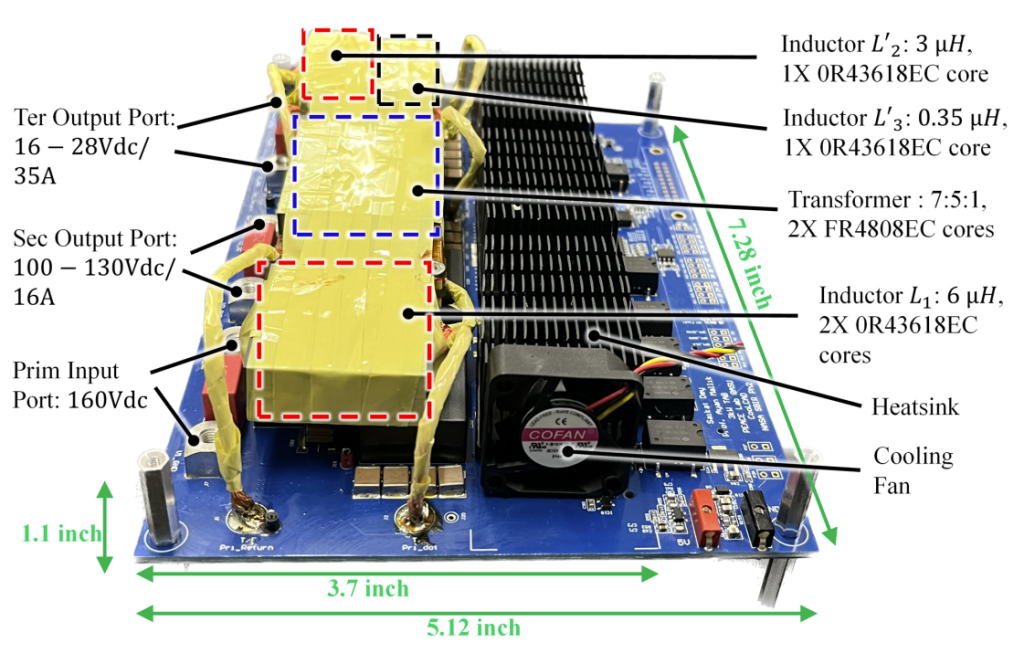
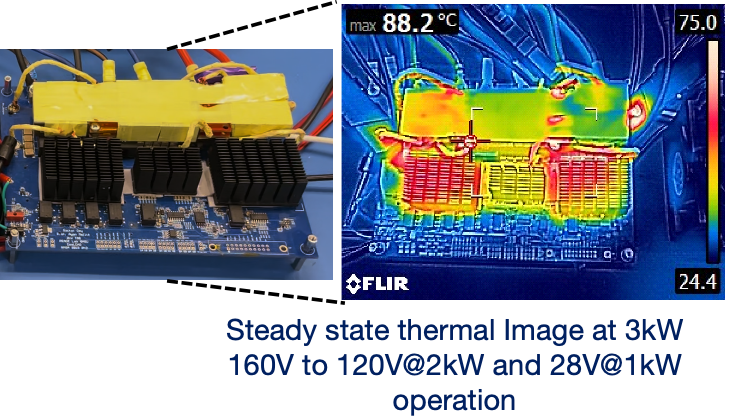
The power management and distribution subsystem in the International Space Station (ISS) operates across multiple voltage levels: a primary bus at 160V (supplied by solar arrays), a regulated 120V DC distribution bus, and a low-voltage battery with a variable range of 16-28V. Traditionally, separate isolated DC-DC converters are placed between each voltage bus to facilitate power exchange. Aiming to miniaturize this existing system, my PhD research, conducted in collaboration with CoolCAD Electronics and funded by NASA, introduced a triple-active-bridge (TAB) modular 9kW all-GaN-based three-port isolated converter system. This innovation integrates these three voltage buses, enabling omnidirectional power flow between ports and achieving a 40% reduction in volume along with a 12% average loss savings.



Multi-port Power Converter for Grid Integration of Renewables
Building on my studies of DC-DC triple-active-bridge (TAB) converters and modulation optimization, I developed a single-stage DC-AC-DC TAB converter as part of a project focused on creating an integrated, deployable, multi-port, multi-directional, and efficient power conversion system (PCS) prototype for a grid-connected solar microinverter with integrated energy storage. This project, supported by the U.S. Department of Energy and in collaboration with HigherWire Technologies, targets disadvantaged off-grid communities in the Navajo Nation, USA. The developed PCS uses an all-GaN-based TAB converter topology capable of seamlessly integrating a 40V DC PV source, a 28V battery, and a 120V AC localized grid through a three-winding high-frequency transformer.
Power Converter for Defense Applications
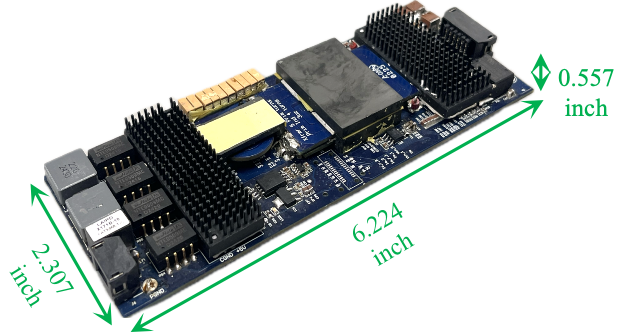
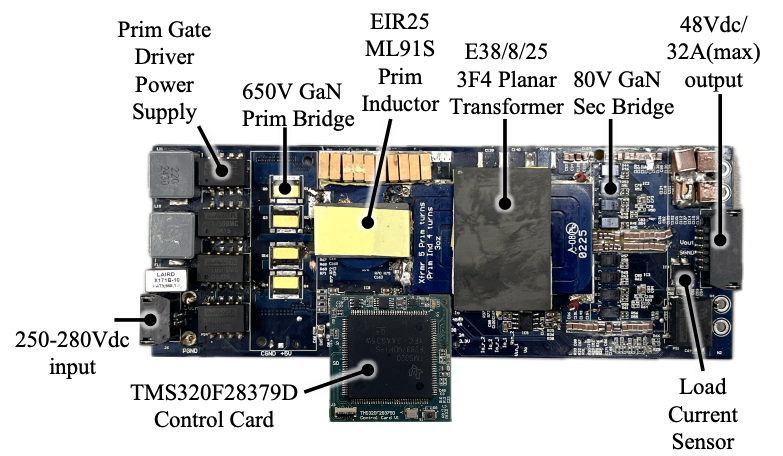
Defense applications, such as airborne radar systems, demand power supplies capable of delivering high-power pulses with exceptional efficiency, compact size, high peak power capability, effective EMI suppression, minimal voltage ripple, and rapid response times. In my ongoing project, funded by the U.S. Department of Defense under the CHIPS and Science Act, I am designing a power converter and its control system for a multi-MHz, >97% efficient, >300 W/in³ power-dense, ultra-fast 230-310V to 48V, 4kW radar power supply. This work is a collaboration with four research teams across ASU, along with three industry partners (Infineon Technologies, Lockheed Martin, ThermAvant) and Sandia National Laboratory. Our research demonstrates that at 2 MHz, a dual-active-bridge (DAB) based modular converter with an optimized transformer design can achieve soft-switching across the entire load and voltage range, reducing conduction losses compared to its LLC counterpart. We employed an interleaved modular design to minimize voltage ripple and implemented a sliding mode control strategy to achieve a settling time of 10 μs for a 100% load transient.
High Temperature Extreme Environment Power Electronics
For space missions like Venus surface exploration, specialized power electronics are essential, capable of operating in extreme temperatures (e.g., 424°C to 447°C for the Venus Mobile Explorer). To address this challenge, I collaborated with CoolCAD Electronics on a NASA-funded project, developing a high-temperature modular SiC power conversion platform. We created a 92% efficient, 28/120/160V to 30-48V high-temperature-tolerant, non-inverting buck-boost converter using high-temperature components, including SiC bare dies, powder-core inductors, and ceramic capacitors. I proposed an innovative SiC die integration technique within a half-bridge module structure to minimize loop inductance in high di/dt paths. We characterized each power stage component and the full converter’s performance across temperatures, benchmarking inductance, capacitance, and leakage current up to 250°C. This project gave me valuable experience in component selection and power converter design for harsh environments, and the findings were published in of IECON 2021, WiPDA 2021, and APEC 2022, where I received a Best Presentation Award.
Future Research Direction
Solid State Transformers (SSTs) – Renewable Integration, EV Charging, Data Centers
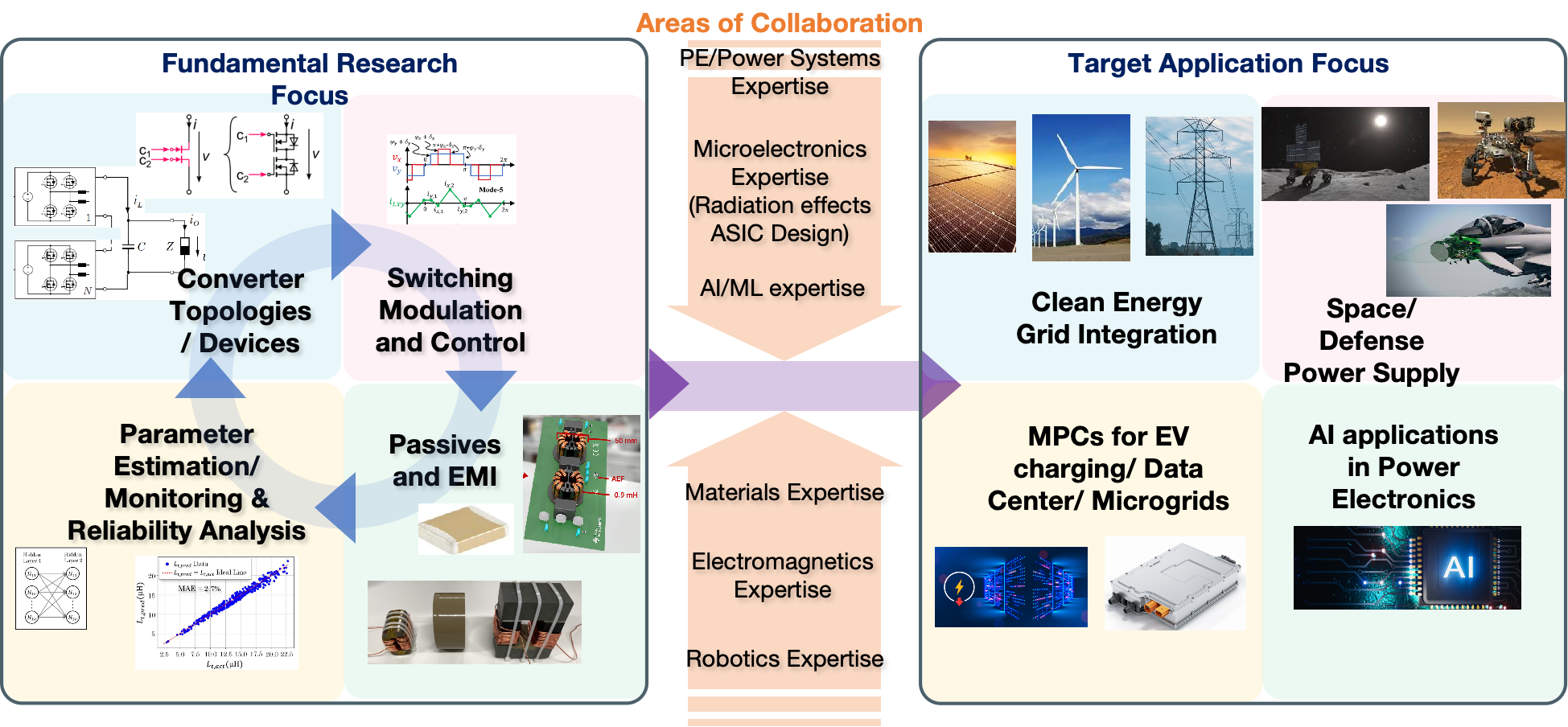
SSTs serve as power electronics interfaces between the medium-voltage grid and renewables, distributed energy storage, electric vehicles (EVs), and DC or AC loads while enabling full-range control of voltages and currents, thus managing active and reactive power flow. My research team will aim to develop single-stage, single- and three-phase AC/DC-AC SSTs using high-frequency resonant or non-resonant links coupled between H-bridges housing newly developed monolithic bidirectional switches (M-BDSs). This approach reduces power loss, size, and cost by eliminating the line-frequency unfolder, and improves system reliability by removing the electrolytic capacitor of two-stage SSTs. Further, to achieve soft-switching of high-frequency devices over the entire AC line cycle and load range, optimized modulation strategies can be proposed involving extended phase shifts and frequency, building on my prior DC-AC microinverter work (ECCE 2024). For medium-voltage DC or AC link-based SSTs, multilevel DAB type topologies will also be explored.
Multi-port omnidirectional integrated Power Converters – Space, EV, Microgrid
For applications such as grid-connected renewables with integrated battery storage, lunar AC/DC microgrids, space station power supplies, on-board EV chargers with auxiliary power modules, and energy routers, multi-active-bridge-based multi-port DC-DC or DC-AC topologies with resonant or non-resonant links offer size, cost, and loss reductions, though they require more sophisticated control. My Ph.D. research demonstrates that loss-optimized soft-switched modulation techniques are feasible for such converters with improved modeling, optimization, and implementation strategies. I plan to continue this research, focusing on hardware-based decoupling methods among magnetically coupled ports to enhance transient stability. Designing efficient universal bidirectional on-board chargers that achieve soft-switching across full load and voltage ranges is challenging due to varying charging levels (1 kW to 20 kW) and battery voltages (250 V to 925 V). However, soft-switching achievement and EMI noise reduction is possible with dynamic DC bus regulation and optimized multi-variable modulation of the DC-DC stage (I filed a U.S. patent on similar technology during my internship at Lucid Motors). My future research group will also focus on single-stage bidirectional AC-DC conversion topologies, especially employing M-BDSs in the AC-side H-bridge, which requires exploring active power pulsation buffer circuits to reduce the need for large electrolytic capacitors. In these applications, modular converter architectures are essential for fault tolerance and increased power throughput, presenting research opportunities in active or unequal load sharing among modules to ensure maximum efficiency by retaining soft-switching in all modules (INTELLEC 2024).
Artificial Intelligence (AI) in Power Electronics – Parameter Estimation, Control, Reliability Analysis, Design Optimization
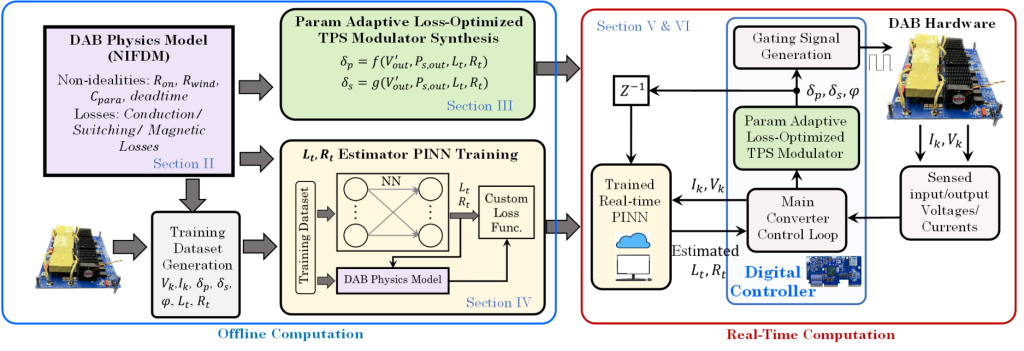
The increasing demand for advanced, miniaturized, high-frequency, WBG-based power converters in critical applications necessitates research in online circuit parameter estimation, reliability analysis, and holistic design and control optimization to ensure safe, reliable, efficient, and noise-immune power conversion. Leveraging the growth of AI and AI-implementable DSPs/FPGAs, I plan to use physics-informed machine learning (PINN) approaches to develop flexible, generalized, and reliable online multiparametric estimation methodologies. By employing convolutional neural networks (CNNs) and long short-term memory (LSTM) models coupled with circuit physics, we can accurately estimate key circuit parameters – device on-resistances, tank inductance, capacitances – that vary due to electrical conditions, environmental factors, and aging. This enables real-time optimization of converter control variables upon parametric deviations to ensure peak efficiency tracking (I successfully implemented a PINN-in-loop real-time loss-optimized modulation strategy for a DAB converter; paper under review at IEEE TPEL). Additionally, I will lead research to perform component and circuit-level reliability analysis by predicting the remaining useful life (RUL) of components using recurrent neural networks (RNNs) and LSTM models trained on aggregated aging datasets.
Operating power converters at frequencies of 500 kHz and above introduces challenges such as elevated winding and core losses, increased transformer parasitics, higher switching and conduction losses (higher dynamic 𝑅𝐷𝑆,𝑜𝑛), and increased EMI noise. A systematic, multi-objective optimization approach is needed to provide optimal circuit/component design choices and modulation strategies. I envision a machine learning-based nested optimization framework that automates design and modulation decisions based on: 1) Component level loss models for switching semiconductors, magnetic cores and passives; 2) EMI Noise Model developed based on switching transients, parasitic capacitances (TPEL 2021, TPEL 2024); 3) Unified Circuit Model developed based on a generalized frequency-domain analysis applicable to various converters (ECCE 2024). Extending this approach to more topologies and including thermal models has the potential to provide scalable and rapid design solutions for next-generation power converters.
Capacitive Wireless Power Transfer (CWPT)
CWPT is a promising alternative to inductive wireless charging for applications like autonomous EVs, eVTOLs, robots, and underwater unmanned vehicles due to lower costs, elimination of core losses, more compact and lighter designs. However, challenges include optimal design of the capacitive coupler, shifts in resonant frequency and mismatched parasitic capacitances during dynamic charging and misalignments. I have a plan to apply real-time parameter estimation techniques using neural nets to identify the reactance of misaligned couplers, allowing dynamic adjustment of the switching frequency to ensure efficient power transfer. Additionally, I intend to investigate Coss hysteresis losses, which is significant at switching frequencies above 5 MHz operation, and explore resonant gate-driving technologies to minimize driver losses, thus improving overall system efficiency.