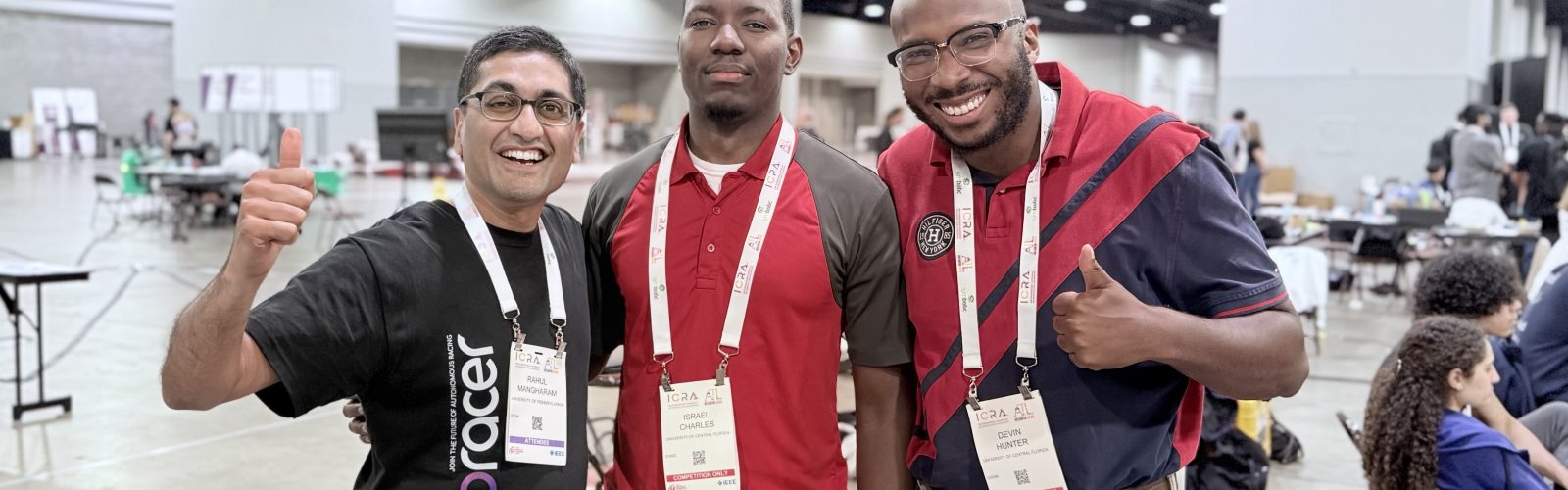
A student-built racecar that started off as a senior design project has exceeded all expectations with a Top 10 finish at the Roboracer Autonomous Grand Prix Competition, held at the IEEE International Conference on Robotics and Automation (ICRA).
The 1/10 scale, autonomous vehicle was built by computer engineering graduate Israel Charles ‘25, along with his fellow senior design team members: computer engineering graduate Asa Daboh ’25, computer science graduate Owen Burns ‘25, electrical engineering graduate Casey Jack ‘25, and mechanical engineering graduate Tevin Mukudi ’25.
“Together, we saw this project not just as a class requirement but as a chance to do something that aligns with UCF’s culture of innovation, and to make a mark in a field we’re passionate about,” Charles says. “I decided early on that I wanted our team to not only build one of these vehicles but also aim to qualify for the competition.”
Simply qualifying for the ICRA event, the team’s original goal, was an incredible win. Their car had to adhere to a strict set of specifications to be approved for the race, including those for the overall size of the car, chassis configuration, computational power requirements and the limitations of its sensors.
“This project was an incredible learning experience that pushed us far beyond the boundaries of the classroom,” Charles says. “One of the biggest takeaways was realizing how crucial interdisciplinary collaboration is. The mechanical design, electrical systems and software all had to integrate seamlessly to bring the car to life.”
To race the vehicle, the team developed algorithms that would allow the car to perceive the track and avoid colliding into other vehicles, all while putting the pedal to the medal to earn a qualifying time that would allow them to participate.
“The most critical requirement was demonstrating that the car could operate fully autonomously,” Charles says. “This meant navigating a racetrack, avoiding dynamic and static obstacles, and maintaining stable control for at least one minute without any human intervention.”
They not only qualified for the race but also placed ninth overall out of a field of 25. Charles says he is especially proud of their achievement since they entered the competition as undergraduates and many of the other competitors were graduate students.
“Competing live showed us not only how much we had grown but also gave us a global perspective on where we stand in this rapidly advancing field,” he says. “It was both humbling and motivating to see our work alongside teams from some of the world’s top universities.”
Charles came to UCF after learning it was ranked one of the nation’s most innovative and fastest-growing universities, and located along Florida’s high-tech corridor.
“I wanted to be part of a university that doesn’t just keep pace with changes, but also leads them to make sure that I would graduate with cutting-edge knowledge and skills,” he says. “I knew I would be provided with access to major engineering companies and industry leaders, and incredible opportunities for internships, networking and real-world experience.”
As he worked toward his bachelor’s degree in computer engineering, Charles realized that his penchant for problem-solving, along with his passion for improving safety and efficiency in complex systems, made for a perfect fit for the new master’s degree in robotics and autonomous systems. He joined the program in Fall 2025.
“Its curriculum reflects the cutting-edge research and industry demands of today,” he says. “The program’s emphasis on practical application perfectly aligns with my ambition to create impactful technologies that address real-world challenges.”
Inspired by his team’s work on their racecar, Charles has made it his mission to encourage others to race small-scale autonomous vehicles. He started a new registered student organization, F1Tenth@UCF, that invites students to build, program and race vehicles at F1Tenth competitions, with a focus on hands-on learning and collaboration.
“I want this organization to be something that not only enriches the student experience during my time here but also continues to grow and evolve long after I graduate, becoming a pillar of UCF’s culture of innovation.”
- Written by Bel Huston