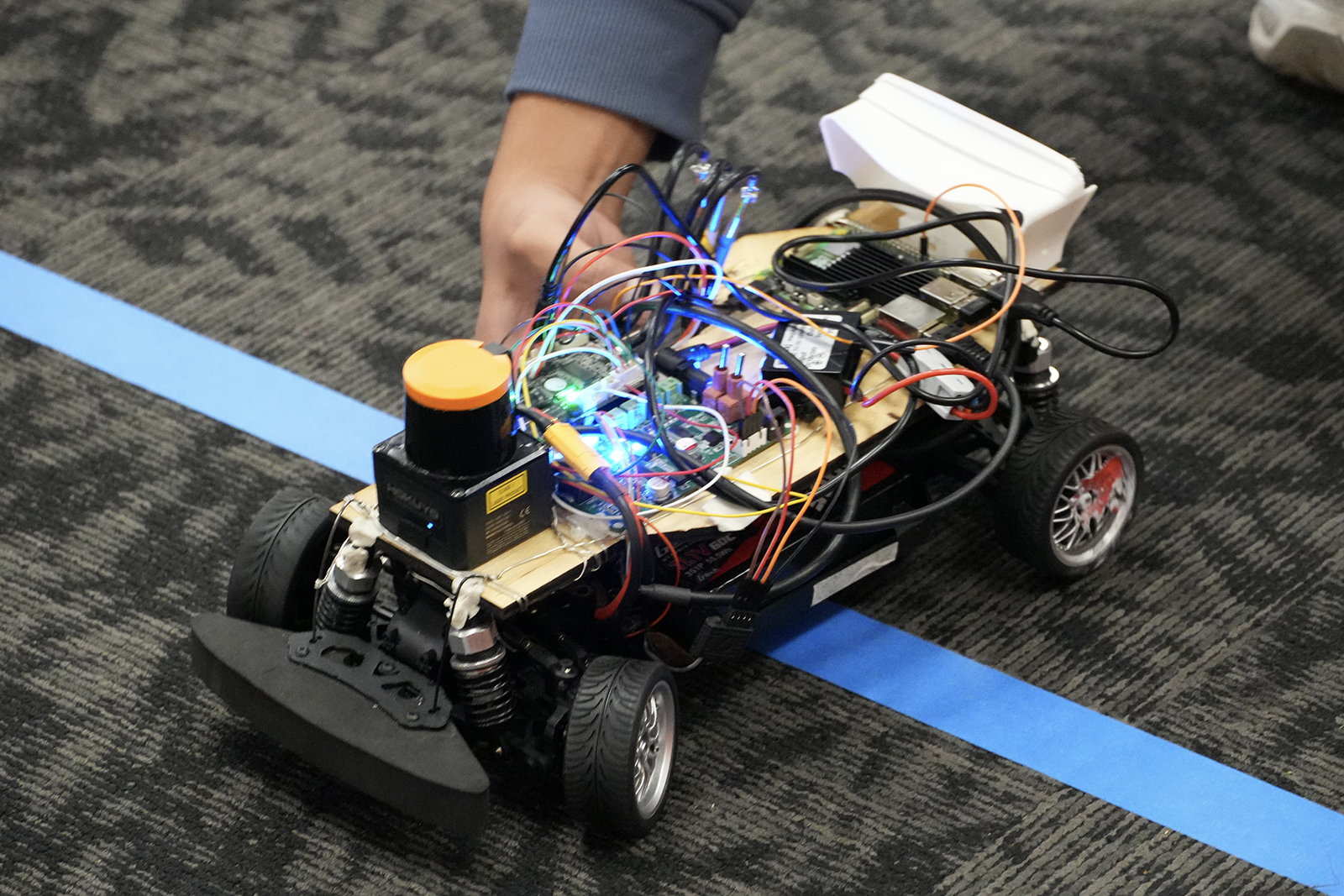
A racetrack victory from a senior design project has turned into a win for the broader UCF community. The AI Racer Club, a new registered student organization, has gained traction thanks to the innovative drive of an electrical engineering graduate student.
The club, previously known as F1Tenth@UCF, is the brainchild of robotics and autonomous systems master’s student Israel Charles ’25. He was inspired to create the group after a car built by his senior design team finished in the Top 10 at last year’s Roboracer Autonomous Grand Prix Competition, held at the IEEE International Conference on Robotics and Automation.
Since then, he’s been motivated to share his passion for racing small-scale autonomous vehicles with other Knights.
“We founded the club to build a self-sustaining student community around autonomous vehicles here at UCF,” Charles says. “The goal is to create a central entry point for students interested in autonomous systems, where they can learn, explore and gain hands-on experience with the technologies that define the field.”
Formed last fall, the club focuses on designing, building, programming and racing small-scale autonomous racecars. Teams must develop algorithms so that the cars can navigate a track, avoid obstacles with no human intervention and of course, be able to perform these tasks at full throttle to pull ahead of the competition.
Students from any major are welcome to join the club, from novice racers to those who already have a technical background. Members need only an interest in autonomous systems and a desire to learn more.
“We provide a structured pathway that helps anyone interested in the field develop confidence as they collaborate on meaningful, multidisciplinary projects,” Charles says. “Beyond that, we encourage experimentation and creativity through internal competitions that emphasize problem-solving and teamwork.”
He adds that members benefit from technical and professional growth with their involvement in the club, gaining valuable hands-on experience in programming autonomous systems, honing their problem-solving skills and working effectively with others in a team setting.
“We host hands-on workshops that cover key technologies in autonomous systems and provide structured learning opportunities to anyone interested,” he says. “These workshops support students as they progress from foundational knowledge to building fully functional autonomous vehicles.”
The club hosted its first flagship event, the AI Racer Grand Prix, last week. A total of six cars qualified for the event, designed by independent teams, research labs and other engineering clubs. Trophies were awarded to the top three teams, as well as special awards to the remaining teams: the Overcoming Obstacles Award, Iron Will Award and the Resilience Award.
“Our club is collaborative by design,” Charles says. “We actively work to bridge different engineering-related organizations under a shared interest in autonomous systems. By integrating our projects with other clubs and collaborating with research labs, we create multiple pathways for students to get involved.”
AI Racer Club members all have an impressive win under their belts regardless of how their cars perform on the track, thanks to practical experiences that have lasting benefits as they prepare for future careers.
“Members should leave the club with greater confidence in their abilities, a stronger understanding of real-world engineering challenges, and exposure to research and career opportunities in the field,” Charles says. “Just as importantly, we hope they build meaningful connections with peers who share similar interests.”
Written by Bel Huston | April 24, 2026