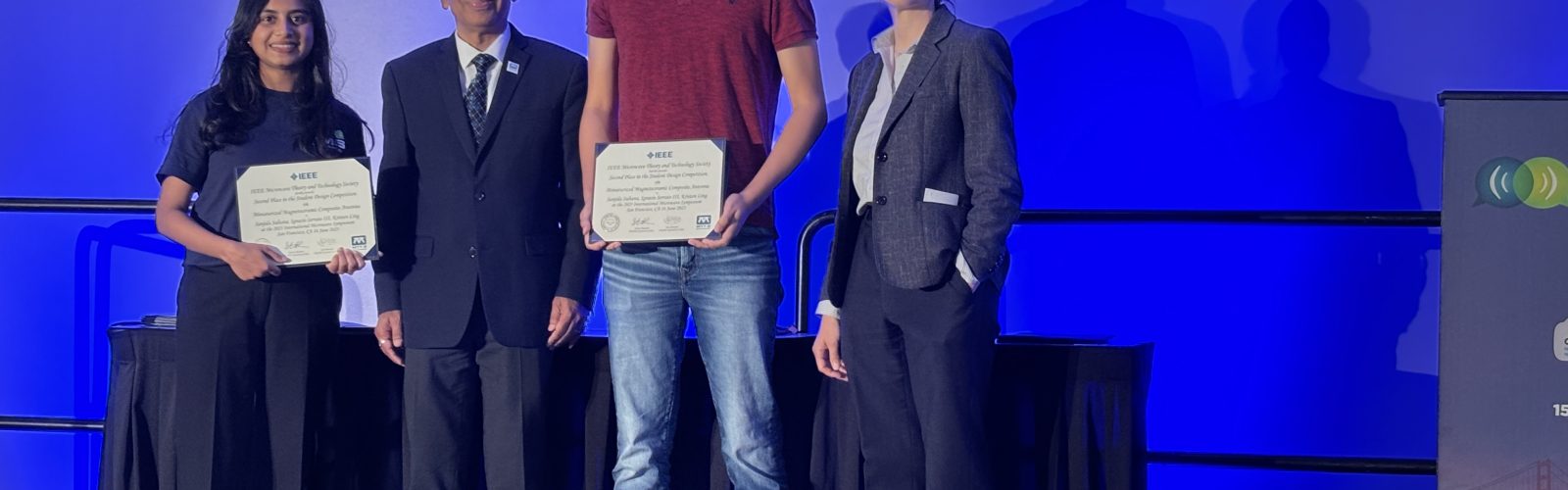
Two graduate student teams from the UCF Department of Electrical and Computer Engineering won awards at the 2025 International Microwave Symposium design competitions, held last month in San Francisco.
The winning electrical engineering student team members — Niteesh Bharadwaj Vangipurapu, Pingzhu Gong and Jiachen Guo from Professor Kenle Chen’s research group, and Sanjida Sultana, Ignacio Serrato and Kristen Ling, researchers for Assistant Professor Piotr Kulik and Professor Xun Gong — came away with first and second place finishes in their respective competitions.
“This achievement highlights UCF’s commitment to hands-on, cutting-edge engineering education,” says Kulik. “It underscores the global relevance of its students’ work in advancing emerging communication radio frequency technologies.”
Doctoral students Vangipurapu, Pingzhu Gong and Guo took home the first-place award from the high efficiency power amplifier design competition. They earned a $1,500 award and the opportunity to submit their design to IEEE Microwave magazine. The trio are members of the Intelligent, High Speed and Integrated Radio Electronics Lab, directed by Chen.
“Notably, this achievement marks the fourth time Dr. Chen’s research group has received this distinction, reflecting a sustained record of excellence in high-efficiency RF power amplifier design,” Vangipurapu says.
Tasked with building a power amplifier (PA), used in telecommunications to boost signal strength for antennas, the team had to ensure their entry produced maximum output power, while also minimizing signal distortion and energy expenditure.
“To be practical in real-world applications, PAs must perform this function while consuming as little energy as possible,” Vangipurapu says. “This high efficiency helps conserve battery life and reduce heat, making devices more reliable and longer lasting.”
The team built the PA in Chen’s lab and were given just 10 minutes to set it up and make the necessary adjustments before presenting it to the judges for evaluation at the conference.
Vangipurapu says they were thrilled with the results.
“It was a rewarding moment after months of hard work, late nights in the lab and overcoming technical challenges,” he says. “We take this opportunity to acknowledge the invaluable enthusiasm and motivation of Dr. Chen, who shared his experiences as a student who participated in the competition himself.”
Their fellow Knights also shined at another student competition, hosted by the conference on the same day a few hours later.
Doctoral students Sultana, Serrato and Ling took second place in the miniaturized magnetoceramic composite antenna competition, earning a $1,000 prize. Sultana and Serrano are researchers at Kulik’s Advanced Integrated Magnetics and Sensors Lab, and Ling is member of the Antenna, Radiofrequency and Microwave Integrated Systems Lab led by Xun Gong.
“Magnetoceramic antennas are used in real-world systems that demand compact size and high-frequency performance, such as satellite communications, defense, aerospace, 5G infrastructure and consumer electronics,” Sultana says. “Their magnetic properties allow size reduction without compromising performance.”
She adds that the antenna built for the competition, which took a month to construct from concept to completion, could be adapted for portable wireless communication modules.
The antenna specifications mandated the use of a material they had not worked with before — a novel substrate, MAGTREX 555, sponsored by the Rogers Corporation. Sultana noted that it was challenge to keep the material from overheating during the fabrication process, but one they overcame after about a week of testing.
She says her team was incredibly proud of the outcome.
“Designing an antenna with a novel material like Rogers MAGTREX 555 while having no prior hands-on experience was a real challenge,” Sultana says. “We put in long hours, ran a ton of simulations and dealt with plenty of trial-and-error in the lab. Getting recognized in the final round was a solid validation of the effort we put in.”
- Written by Bel Huston