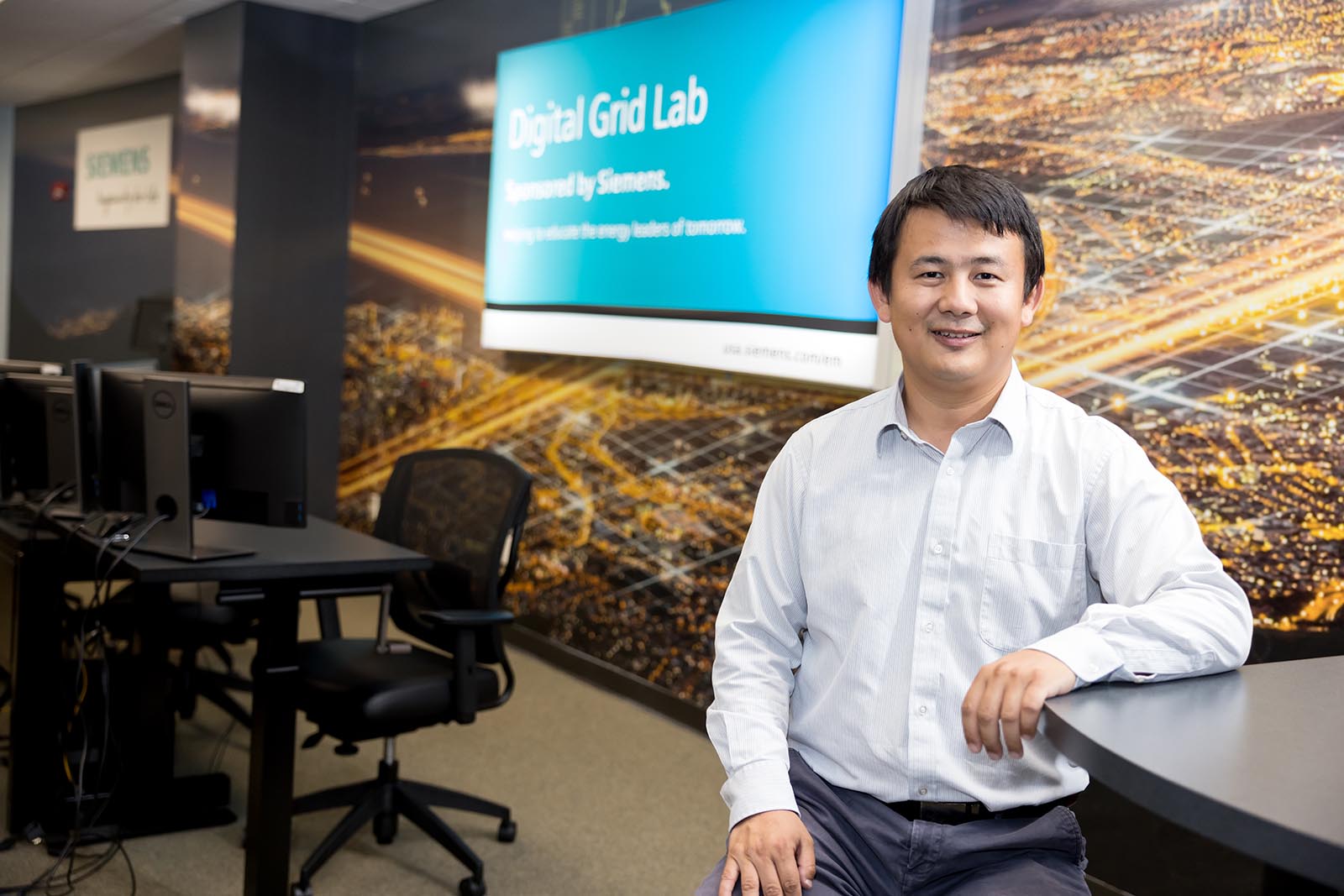
For Professor Wei Sun, teaching goes beyond textbooks and exams. It’s about watching students grow, helping them find their passions, and preparing them for their future career paths.
That philosophy is what led to his selection for the 2026 Excellence in Undergraduate Teaching Award at the college level.
“It is one of most rewarding things for an educator, when you put your students first and try your best to provide best education for them,” Sun says. “You watch them learn, grow, mature and get ready for next step in their careers.”
Sun keeps his students engaged by connecting the knowledge they’ve gleaned from a textbook to hands-on projects that allow them to put their newfound knowhow into practice. For the past decade, Sun has taught Fundamentals of Electric Power Systems, a course that has considered challenging for students. Over time, he’s implemented team projects that explore the latest grid technologies, organized field trips to local power companies, and tied his teachings to students’ capstone project.
“I designed seven modules to teach students how to use the professional software for power system analysis, and enable to modify a real-world industry project for Senior Design so students can perform similar tasks as power engineers,” Sun says. “Many students think this is the best of all experiences in this class and always receive excellent feedback from alumni when they join the power industry after graduation.”
Sun hopes that when students leave his class, they walk away with a solid foundation in power engineering and an understanding of the variety of career paths ahead of them. One such student, Nicole Parker ’24, earned her bachelor’s degree in electrical engineering and now works as a protection and automation engineer for Siemens. Sun credits her as one of his most successful students – she not only received the Order of Pegasus, the highest achievement for a UCF student, but won the Institute of Electrical and Electronics Engineers Power and Energy Society Scholarship and Best in Show during the Senior Design Showcase. Since Parker’s graduation, Sun’s students have continued to build off of her team’s project.
He says that mentorship at the undergraduate level is rewarding for both him and the students.
“Most students come to college without a very clear picture of what’s next for them, or how to build a career path, even where to start,” Sun says. “They need help, especially from faculty who can share lessons and experiences with them, give them guidance and support, and always be there to answer questions. Students can always learn new things by themselves, but those face-to-face interactions show that someone cares for them and is always willing to help.”
His advice to other faculty who mentor undergraduate students is to place them as the top priority.
“You need to care for them from your heart, rather than just teaching a class,” Sun says. “One may argue about what is the essence of education, but for me, to see them grow and become mature and successful is the most everlasting reward for an educator.”
Written by Marisa Ramiccio ’11 | March 25, 2026